
Hyundai Ioniq 9 Review: better than a Kia EV9?
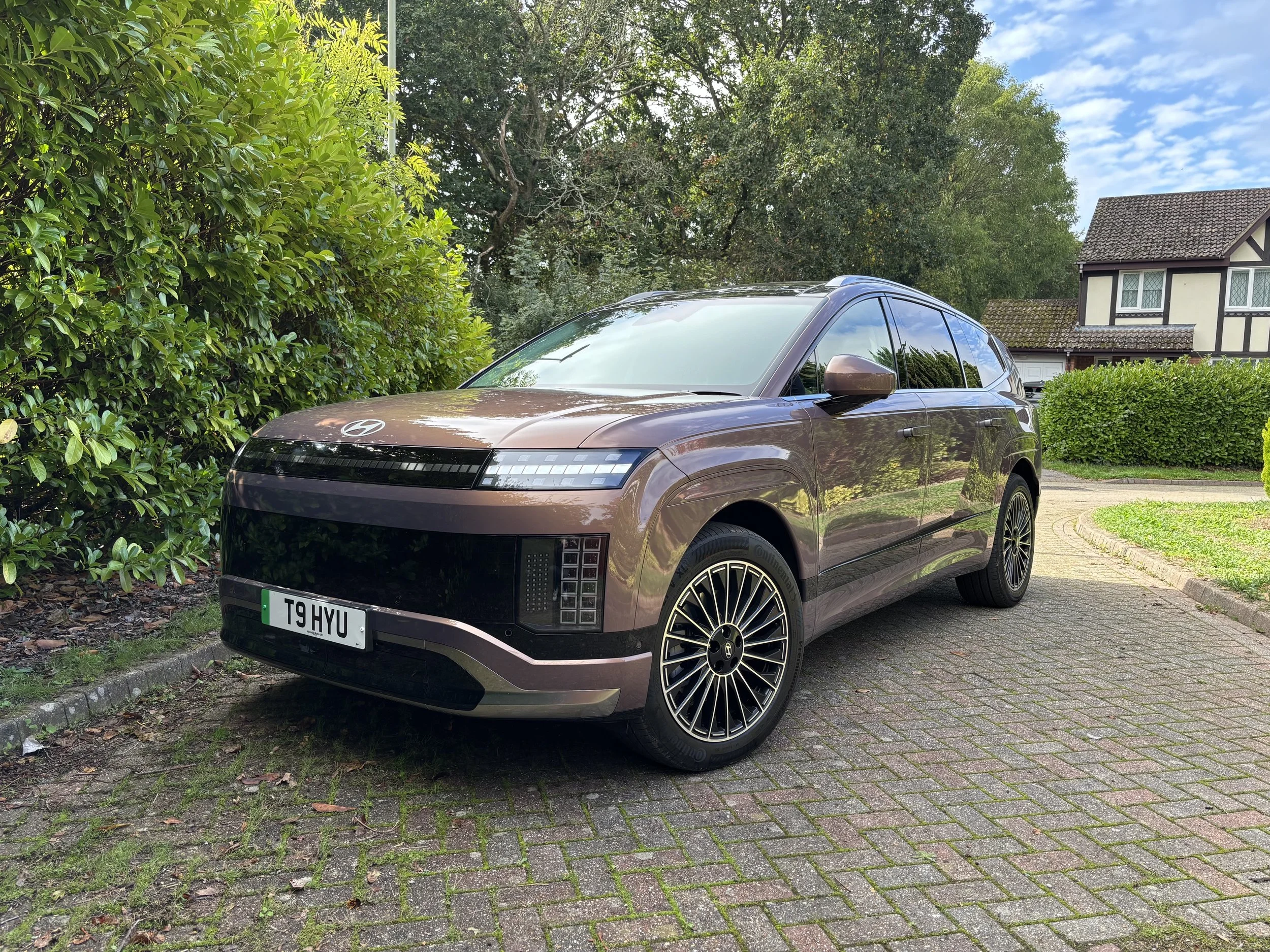
The Ioniq 9 is Hyundai’s flagship electric SUV. (Cameron Richards)
Hyundai offers some of the best electric cars on the market, ranging from the funky Inster city car right up to the full-blooded Ioniq 5 N.
With demand for larger electric SUVs growing, Hyundai has taken a punt on this sector with the Ioniq 9 – a premium, electric SUV that’s available in six- or seven-seat interior configurations and is a rival to the Kia EV9 and Volvo EX90.
So, has Hyundai just set a new benchmark with the Ioniq 9, or is the Kia EV9 the ultimate Korean electric SUV?
Updates
It sits on the same E-GMP platform as the Kia EV9. (Cameron Richards)
The Ioniq 9 is Hyundai’s flagship model, and although it’s a direct competitor to the Kia EV9, it actually shares the same E-GMP platform with its Korean counterpart.
However, that’s where the similarities end, as the car features Hyundai’s pixel-themed exterior detailing and a cabin that oozes style, class and quality.
Customers can choose from a choice of rear-wheel-drive and all-wheel-drive setups, and there is just one battery pack available.
Engines and transmissions
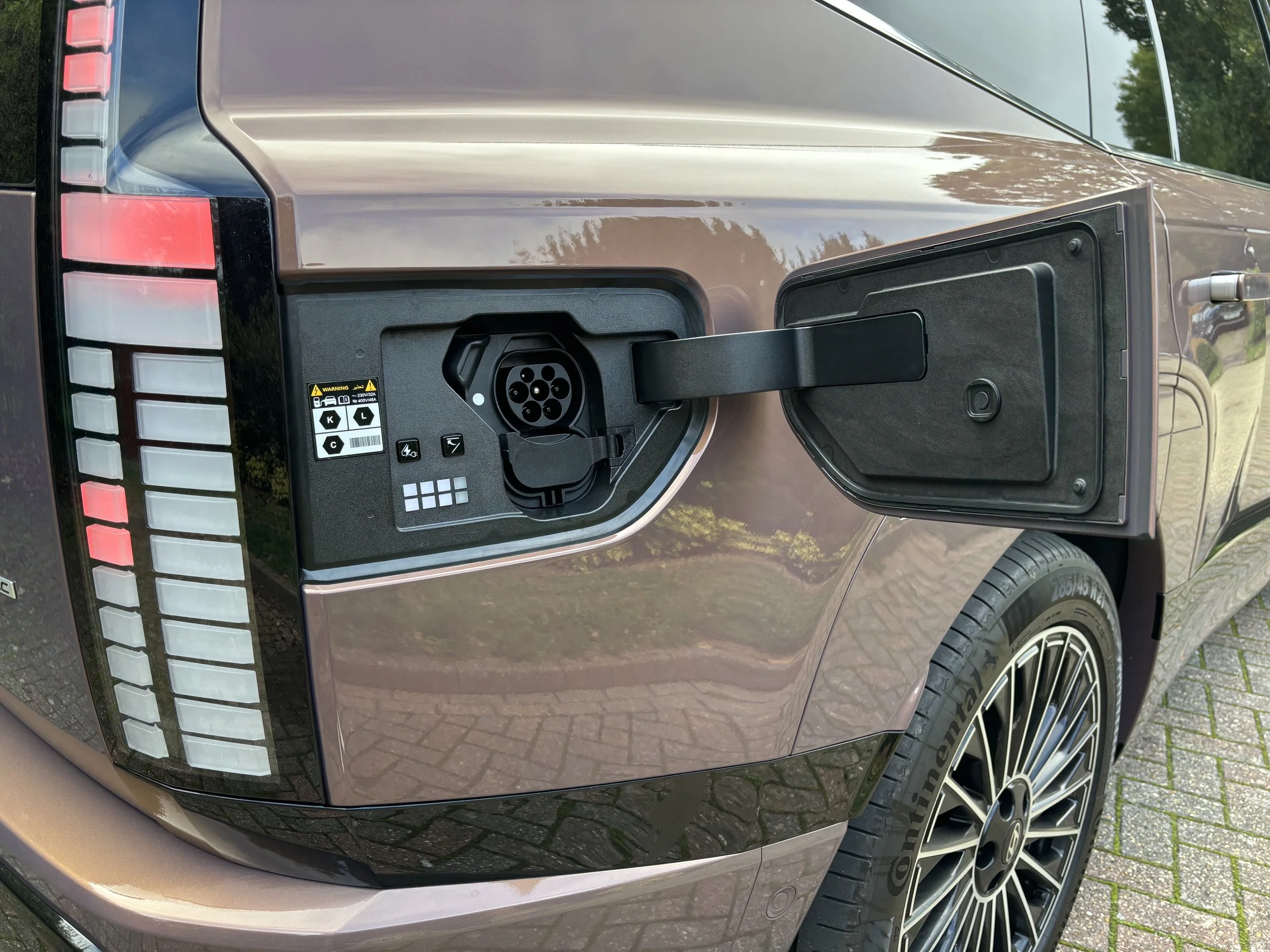
It’s powered by a 110kWh battery pack with a choice of rear-wheel-drive and all-wheel-drive setups. (Cameron Richards)
Every Ioniq 9 is hooked up to a 110kWh battery pack, but our test car features a dual-motor setup that provides all-wheel drive.
In this configuration, it produces 421bhp and 700Nm of torque, while 0-60mph takes just five seconds and the car maxes out at 124mph.
Hyundai claims that this model can achieve a range of 373 miles between charges, and every model is fitted with an 800-volt architecture, which supports DC rapid charging speeds of up to 233kW, allowing a 10 to 80 per cent top-up to be completed in 24 minutes.
The rear-wheel-drive model is available with 215bhp and 303bhp power outputs, and can travel up to a claimed 385 miles in the lower-powered variant.
Behind the wheel
The Ioniq 9 is comfortable and very refined. (Cameron Richards)
Despite its hefty 2.7-tonne kerbweight, the Ioniq 9 is a very impressive car to drive. Our test car is fitted with Hyundai’s ‘Active Noise Control-Road’ system, which works in combination with the 14-speaker Bose sound system, by cancelling out wind and tyre noise from entering the cabin by generating opposite sound waves within the speakers. The result is an ultra-quiet driving experience, while the car’s self-levelling suspension manages to glide over potholes.
The steering in the Ioniq 9 isn’t the most communicative, but there’s plenty of grip from the tyres and very little body lean when you chuck it into a corner.
In town, the car’s sheer size does become apparent, with a lot of planning needed to find a big enough parking space. But, despite a lack of four-wheel steering, the Ioniq 9 has a surprisingly tight 12.5-metre turning circle, which is impressive for a car of this size.
Sadly, during our tests, the car only averaged 2.8 miles per kWh, working out at a real-world range of 308 miles – that’s 65 miles off Hyundai’s official WLTP figure.
Styling
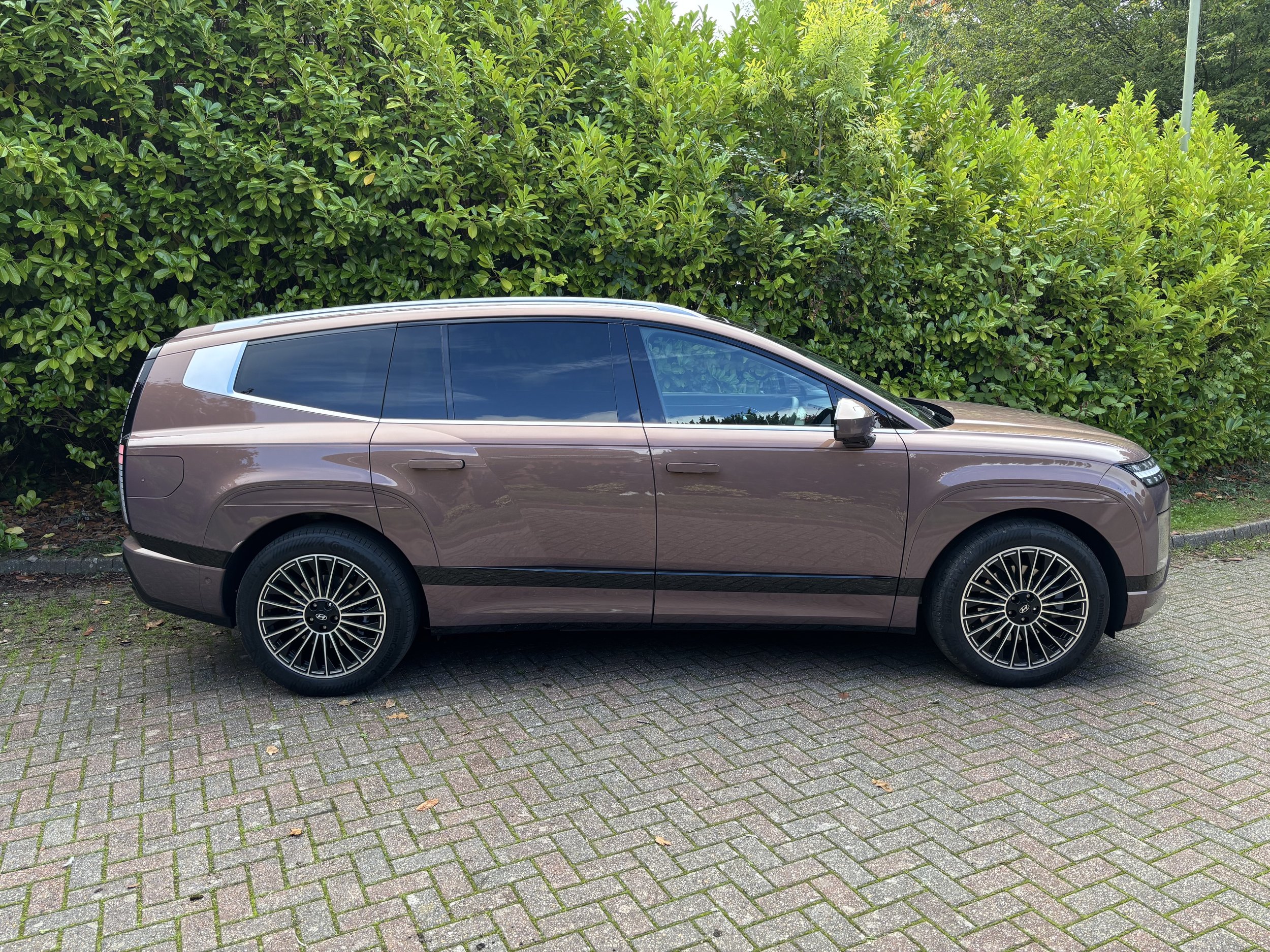
The car uses lots of pixels in its design. (Cameron Richards)
You can’t criticise Hyundai’s design team for the styling of the Ioniq 9, as it’s a great-looking car from every angle.
Hyundai has incorporated plenty of pixel elements into the design, including the pixel LED headlights. The broad shoulder line and muscular wheel arches give it a more broad appearance, although the squared-off wheel arches won’t be to everyone’s taste. Then there’s the tall roofline, flush door handles and kick-up rear C-pillar which gives the car a classier look.
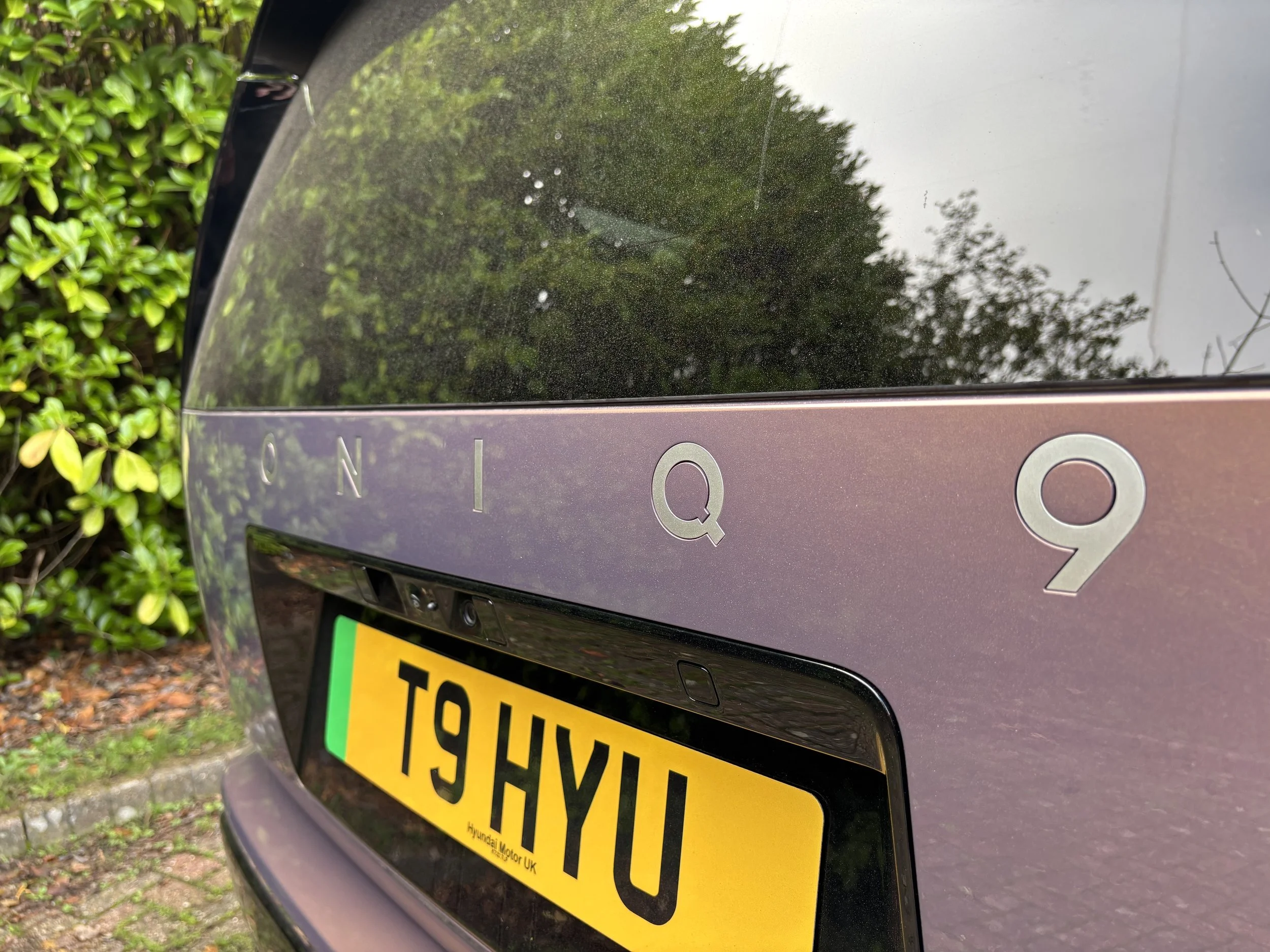
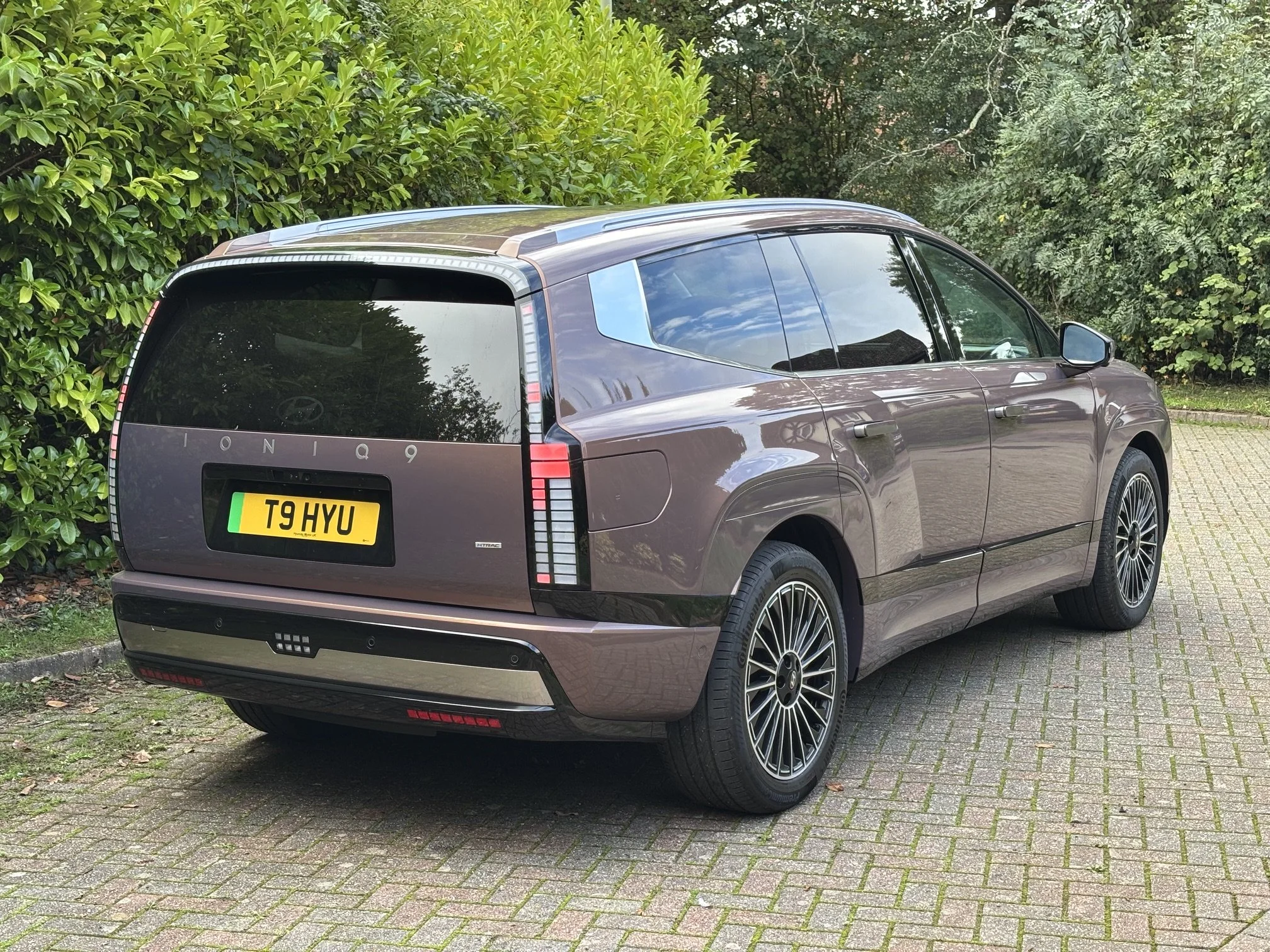
Move to the back, and the pixel theme continues with the high-positioned pixel taillights, which flow around the tailgate into high-level brake light. There is model-specific lettering and more pixel design language found on the reversing light and bumper reflectors.
Compared to the Kia EV9, the Hyundai has a much cleaner, more subtle appearance.
Interior and practicality
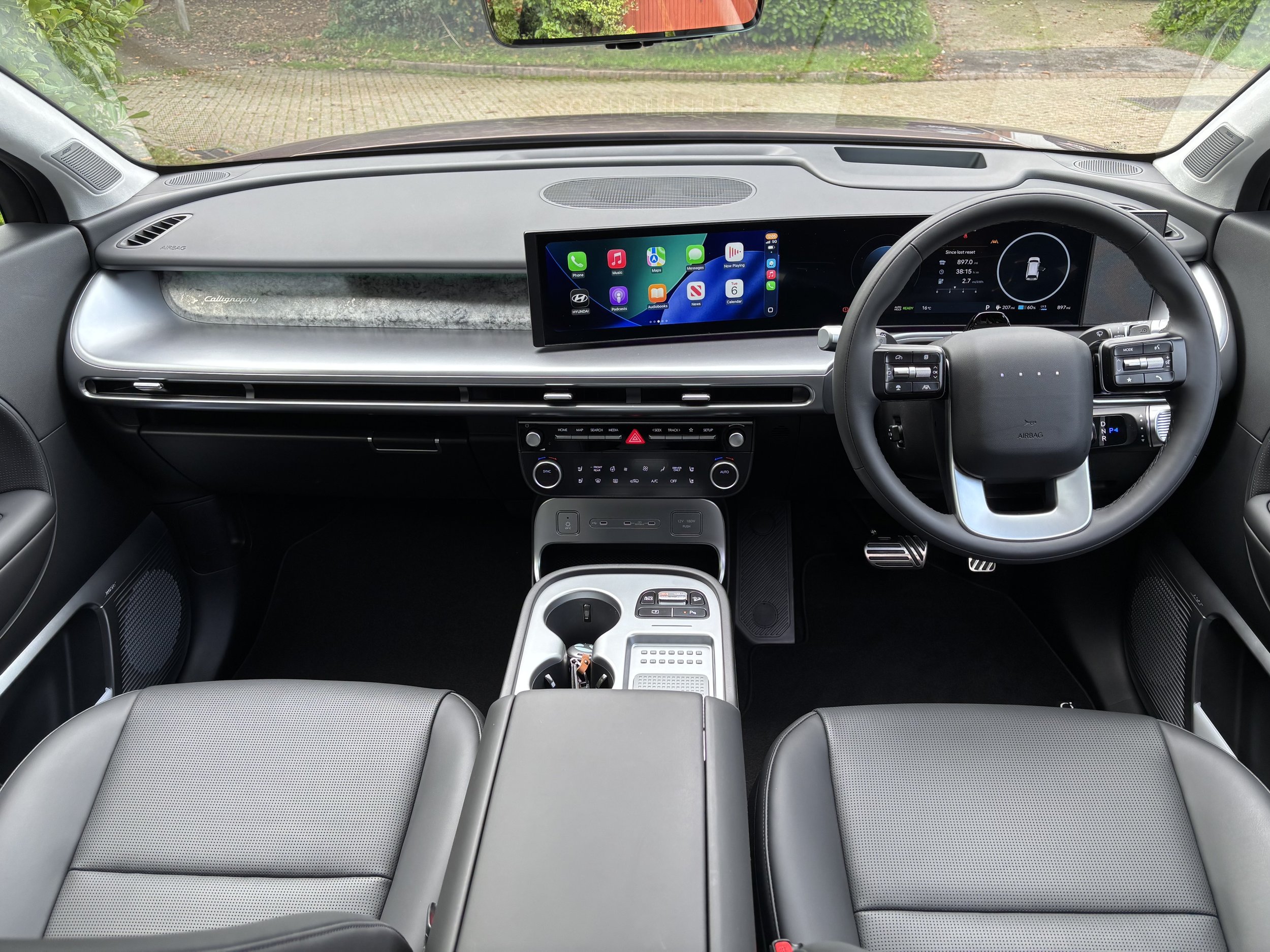
The interior boasts endless amounts of storage and space. (Cameron Richards)
One of the Ioniq 9’s party tricks is the interior, as it’s a really pleasant place to be.
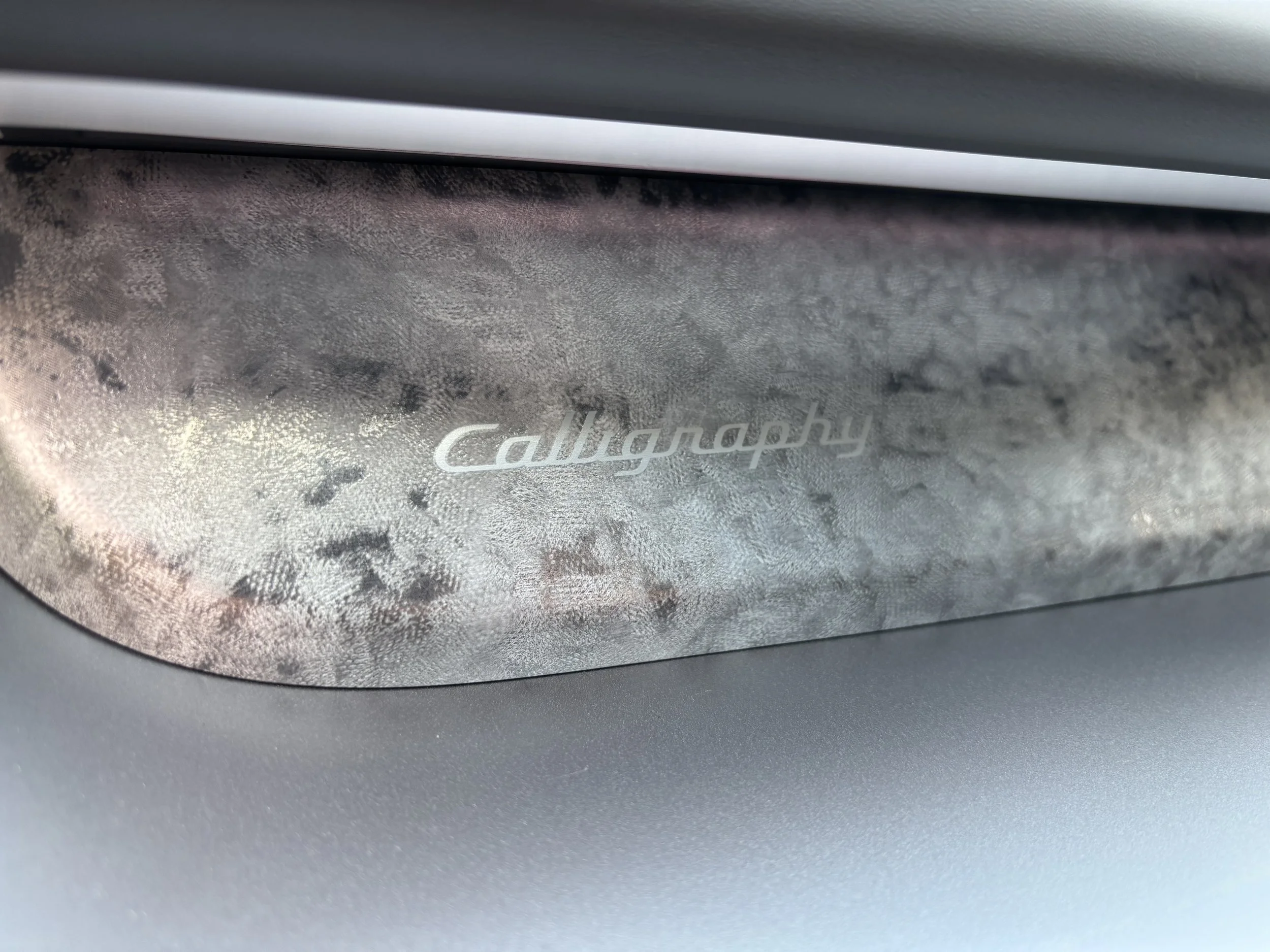
Our top-spec Calligraphy car comes with all the bells and whistles, including Nappa leather seats and a marble-effect dashboard trim with a Calligraphy badge engraved into the material.
Up front, there are lots of soft-touch feeling plastics and physical buttons, including proper dials for the climate control system.
In terms of storage, the Ioniq 9 packs a deep glovebox with a shelf located on top, wide door bins in the front and back, space beneath the climate controls for your mobile phone and a cubby box below that with a built-in UV-C steriliser. According to the manufacturer, the system uses a plasma light to remove up to 99.9 per cent of surface bacteria.
Other storage features include a massive storage area under the armrest, two cup holders and a wireless charging pad.
Our test car is equipped with the six-seat layout, which means you get two individual chairs in the second row with a 2+2+2 configuration. They can rotate 180 degrees, while the seats are also heated and ventilated.
Rear-seat passengers also benefit from their own climate control settings, two aeroplane-style seat back pockets, a rear cubby box, rear sun blinds and armrests. Space isn’t an issue, with plenty of legroom, shoulder room and knee room. The third row of seats can accommodate average-sized adults for short journeys, though the limited legroom will mean they’re best suited for children.
With all the seats in place, the Ioniq 9 offers an impressive 338-litre boot capacity. Fold down the electrically operating third row of seats and that space swells to 908 litres, while the second row of chairs folded down creates a total load bay of 2,419 litres – that’s 509 litres more than a Volvo EX90.
The Ioniq 9 also comes with a 52-litre frunk, although the rear-wheel-drive variant features a larger 88-litre compartment.
Prices and trim levels
The range kicks off with the Premium at £64,995. (Cameron Richards)
Hyundai is one of the more generous manufacturers when it comes to standard equipment and the Ioniq 9 isn’t what you’d call sparsely equipped.
Premium (£64,995): This is the entry-level model, but standard equipment isn’t hampered down, with every car coming with LED headlights, self-levelling suspension, front and rear heated seats, a heated steering wheel, a heat pump, a powered tailgate and 19-inch alloy wheels.
Ultimate (£73,920): The mid-level Ultimate offers all of the kit of the Premium and more, including a pre-conditioning battery system, 20-inch alloy wheels, front and rear ventilated seats, a head-up display and a 14-speaker Bose premium sound system.
Calligraphy (£76,435): Range-topping Calligraphy cars can be specced with six- or seven-seat interior layouts and boast 21-inch alloy wheels, Nappa leather upholstery, a suede rooflining and the UV-C cubby tray.
Calligraphy Black Ink (£79,835): The Black Ink adds black exterior detailing, including black door mirrors, 21-inch black alloy wheels, black trim on the front and rear bumpers, black Hyundai badges and a black-finished aluminium dashboard trim.
The Ioniq 9 also comes with a handy vehicle-to-load (V2L) function, which enables electrical appliances such as a portable cooker or microwave to be plugged in using the car’s battery pack from a three-pin socket located in the boot.
Despite its high price tag, the Ioniq 9 still undercuts the Kia EV9 by £1,650 and the Volvo EX90 by more than £8,000.
Verdict
If you need a big, comfortable, practical and capable electric SUV that can do it all, the Hyundai Ioniq 9 could be the car for you. It has a premium feel and offers an abundance of space inside for the whole family.
It’s not perfect, as its huge footprint can make it tricky to navigate around town, and it isn’t as efficient as it could be. However, compared to the Kia EV9, the Ioniq 9 might just have the edge, thanks to its lower price tag, extensive equipment list and impressive driving characteristics. For those reasons, this big Hyundai surges ahead of the competition in this growing market.
RATING: ★ ★ ★ ★ ☆
If you want a second opinion on the Hyundai Ioniq 9, you can check out Jim Starling’s YouTube review here:
Pros:
Great looks
Premium-feeling cabin
Acres of space
Good to drive
Smooth and relaxing on long journeys
Very refined
Impressive turning circle
Cons:
Too big for Britain’s roads
Difficult to manoeuvre in town
Not as efficient as figures would suggest
FACTS & FIGURES
Model we’ve tested: Hyundai Ioniq 9 Calligraphy 110kWh AWD six-seater
Price of test car: £79,235
Engine: 110kWh battery pack with dual electric motors
Power: 421bhp
Torque: 700Nm
0-60mph: 5.0 seconds
Top speed: 124mph
CO2 emissions: 0g/km
Efficiency on test: 2.8 miles per kWh (308 miles of real-world range)
Claimed electric range: 373 miles
Maximum charging speed: 233kW
